
Can Online Eating Disorder Treatment Really Help You Recover? Here is the Truth About Virtual Specialist Care
For many years, the gold standard for eating disorder treatment was an in-person clinic. The logic was simple: recovery is intense, and therefore it requires a physical presence to be effective. However, as the world has shifted, so has our understanding of what makes therapy "work."
If you are currently struggling with an eating disorder, you might be asking: “Can a video screen really provide the same support as a person in the room?” or “Is online treatment just a second-best option when I can’t find a local clinic?”
The truth is that for many people: particularly those who are neurodivergent, have complex sensory needs, or live outside major city centers: online specialist care is not just an alternative; it is often the more effective choice.
At The Eating Disorders Clinic, we see every day how virtual care breaks down the barriers that traditionally keep people stuck. In this article, we will explore the evidence, de-pathologize the preference for home-based care, and help you decide if a virtual approach is the right "fit" for your journey.
The Evidence: Does Virtual Care Actually Work?
It is natural to feel skeptical. However, clinical research has caught up with the digital age. A 2022 systematic review published in Frontiers in Psychiatry found that digital interventions for Anorexia Nervosa, Bulimia Nervosa, and Binge Eating Disorder significantly reduced symptoms and improved quality of life.
In fact, data from UK specialist services comparing online, in-person, and blended models shows no significant difference in effectiveness. Whether clients were working toward weight restoration or a reduction in binge/purge cycles, the outcomes remained consistent across formats.
The success of treatment doesn’t depend on being in the same room; it depends on the specialist expertise of the team and the therapeutic alliance: the connection and trust you build with your clinician.
Why "Home" is Often the Best Place for Healing
Traditional treatment often happens in a "recovery bubble": a clinical office that looks and feels nothing like your daily life. The challenge comes when you leave that office and return to the kitchen, the dining table, or the grocery store where your triggers exist.
1. Real-World Integration
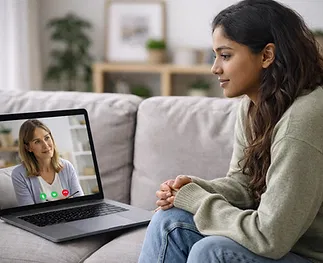
Online therapy allows us to meet you exactly where the challenges happen. We aren’t just talking about a difficult meal in a sterile office; we are supporting you in the very environment where you eat. This allows for direct generalization: the ability to take a skill learned in a session and apply it immediately to your actual life, rather than trying to remember it hours later.
2. The Sensory "Safe Space"
For our neurodivergent clients: those with ADHD, Autism, or ARFID: the sensory tax of traveling to a clinic can be exhausting. Navigating public transport, enduring bright clinic lights, and managing "waiting room anxiety" can leave you too dysregulated to fully engage in therapy.
Virtual care gives you complete control over your environment. You can choose your lighting, your seating, and your fidget tools. You can even have your pets nearby for emotional regulation. By reducing the "sensory tax," you have more cognitive energy available for the deep work of recovery.
Addressing the Common Misconceptions
"Online therapy feels impersonal."
Surprisingly, many people find it more personal. Being in your own space often lowers your defenses, allowing for a level of honesty that can be harder to reach in a formal clinical setting. We get to see "you" in your world, which leads to a more formulation-based approach: one that understands your unique context rather than just your diagnosis.
"I need to be 'sick enough' for a clinic."
There is a common myth that online care is only for "mild" cases. This is not true. Virtual care can be highly intensive. At The Eating Disorders Clinic, we provide a multidisciplinary team approach, including psychologists, dietitians, and occupational therapists, who collaborate closely on your care plan.
The Advantage of Specialist Matching
One of the greatest benefits of virtual care is that you aren't limited by your postcode. In-person care often forces you to see whoever is closest, regardless of whether they have the specific expertise you need.
Through an online clinic, you can be matched with a clinician who truly understands your specific presentation. This is vital for:
Neurodivergent individuals: Who need a professional that won't pathologize their sensory preferences.
Men with eating disorders: Who may feel more comfortable seeking help in a private, discreet virtual setting.
Those with complex ADHD/Binge Eating patterns: Who require a specific understanding of dopamine and executive function.
When Is Online Care Not the Right Choice?
While virtual care is powerful, it is not a "one size fits all" solution. Your safety is our priority. Online treatment may not be appropriate if:
You are experiencing acute medical instability (e.g., very low heart rate, fainting, or severe electrolyte imbalances) that requires frequent physical monitoring.
You are in an acute crisis involving immediate risk of self-harm.
You do not have a private, safe space where you can speak freely.
During our initial assessment, we always screen for medical safety to ensure that the level of care we provide is the right match for your current needs.
Creating a Sustainable Roadmap to Recovery
Recovery is rarely a linear path. It is a process of "understanding before intervention." Online care supports this by offering a level of consistency and flexibility that in-person clinics often struggle to match. Whether you are balancing school, work, or childcare, virtual appointments fit into your life rather than forcing your life to revolve around treatment.

A Gentle Next Step
Deciding to seek help is a significant moment of self-advocacy. If you have been waiting for "the right time" or were worried that online care wouldn't be "real" enough, we invite you to explore further.
You don't need to have a formal diagnosis or be at a specific weight to reach out. We are here to help you understand your relationship with food and your body through a lens of compassion, not judgment.
How we can support you:
Specialist Assessment: A deep dive into your history and needs to create a tailored roadmap.
Multidisciplinary Support: Access to dietitians and therapists who speak the same language of recovery.
Neurodiversity-Informed Care: Support that respects your sensory needs and cognitive style.
Recovery is possible, and it can start exactly where you are right now.
Explore our services or contact us today to learn more about how our virtual clinic can support your unique path to healing.